

Somewhere in your firm right now, there’s a monthly charge nobody can quite explain. It shows up on a credit card statement — forty dollars, maybe sixty — for a tool a project manager signed up for during a busy stretch a couple of years back. The project is long since complete and the person who set it up moved to another role. The charge keeps right on going.
On its own, it’s nothing. A rounding error. The trouble is that it’s almost never on its own.
Software today gets bought the way job-site coffee gets bought: one person, one card, one click. There’s no purchase order, no approval, no central list. A designer needs a file converter this afternoon and signs up before lunch. A superintendent wants a better way to share photos from the field and expenses it the following week. Each decision is small, sensible, and completely invisible to everyone else. Multiply that across a few years and a few dozen people, and you’ve built a second equipment yard nobody is managing — full of rentals that were never returned.
The pile is bigger than you think
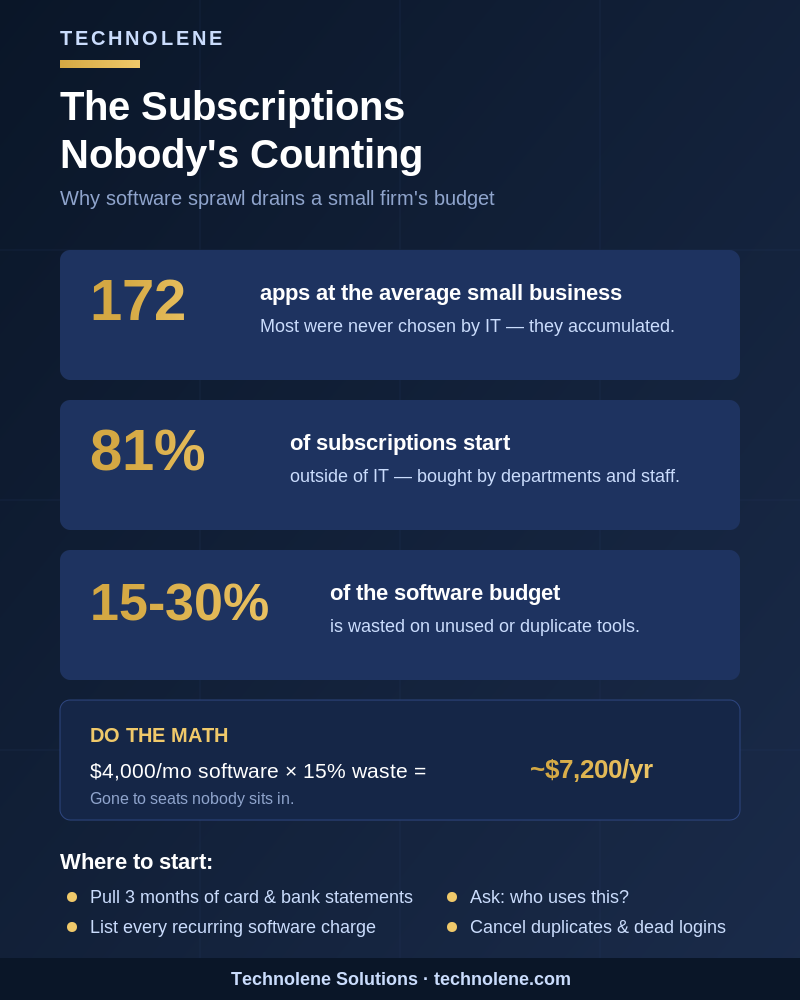
The average small business — under 500 employees — is running about 172 different software applications. [1] Not 172 that anyone chose on purpose. 172 that accumulated. And most of that spending never passes through whoever handles your IT: industry data shows roughly 81% of software subscriptions are initiated by individual departments and staff rather than a central owner. [2]
The stack didn’t get designed. It got deposited.
That matters because a tool nobody chose is also a tool nobody is tracking, renewing deliberately, or turning off when it stops being useful.
The math nobody runs
Here’s where it gets expensive. Analyst firm Gartner has long estimated that organizations can cut software costs by around 30% simply by eliminating licenses and tools they don’t actually use. [3] Broader industry benchmarks land in the same neighborhood — somewhere between 15% and 30% of a typical software budget is spent on duplicate or unused subscriptions. [4]
Run the numbers on a real firm. Say a 30-person engineering practice is spending $4,000 a month on assorted software — a modest figure once you count design tools, cloud storage, project apps, and communication platforms. That’s $48,000 a year. Trim the waste at the low end of the range, 15%, and you’re looking at roughly $7,200 walking out the door annually for things nobody is using.
That’s not a rounding error. That’s a hire’s worth of health insurance.
It compounds, too. Research consistently finds that more than half of purchased software licenses go unused within the first month. [1] You paid for the seats. Most of them are empty.
Three tools that do the same job
Sprawl doesn’t just cost money on idle licenses — it quietly buys the same thing twice. When every department picks its own tools, you end up with two file-sharing services, three places to run a project, and a couple of overlapping ways to hold a video call. Each was reasonable in isolation. Together they’re redundant, and your team pays the tax in confusion: files in the wrong system, a client looped into the platform half the office doesn’t check.
The exposure you never signed up for
There’s a security cost hiding in here too. A subscription your IT support doesn’t know about is one they can’t secure, patch, or shut off. When the person who set it up leaves, that login often keeps working — sometimes billed to a personal card, sometimes holding client files, always sitting outside anyone’s line of sight. For a firm entrusted with drawings, contracts, and client data, an unknown account is an unlocked side door.
What it costs to keep ignoring it
Left alone, the pile only grows. Nobody wakes up one morning and decides to overspend on software by a third — it happens one forgotten renewal at a time, the same way a garage fills up. The firms that get ahead of it aren’t the ones with the biggest IT budgets. They’re the ones who decided, once, to actually know what they’re paying for.
Where to start
You don’t need a software platform to fix this. You need an afternoon and a list. Pull the last three months of credit card and bank statements, and write down every recurring software charge. Next to each one, answer three questions: Who uses this? Do we already have something that does the same thing? Is it still tied to an active project or person? That single exercise usually pays for itself before you’ve reached the bottom of the page.
If you’d rather not spend the afternoon squinting at statements, Technolene helps AEC and manufacturing firms take a clear inventory of their software — what’s active, what’s redundant, and what’s quietly billing for nobody. No pressure, no jargon. Just an honest picture of where the money is going.
→ Reach out at technolene.com/contact to schedule a conversation.
Sources
- https://jumpcloud.com/blog/saas-usage-statistics-how-much-is-too-much
- https://zylo.com/reports/2025-saas-management-index/
- https://www.gartner.com/en/newsroom/press-releases/2016-07-19-gartner-says-organizations-can-cut-software-costs-by-30-percent-using-three-best-practices
- https://insideconsulting.net/insights/the-hidden-cost-of-too-many-tools-a-saas-vendor-consolidation-guide/