

Every firm has one. You know, the person you call when you can’t connect to the server, when a new hire needs an email account, when your accounting software throws an error nobody’s seen before. Sometimes it’s a partner who just did it. Sometimes it’s the office manager who quietly took it on because no one else would. Either way, things work — quietly, reliably — right up until the day that person isn’t there.
It doesn’t take a resignation. They could be on that two week vacation (some place with no cell service or over seas), have a family emergency or a stint in the hospital, that is all it takes.
The systems didn’t fail. Instead the one person who understood them just became unreachable.
How the knowledge ends up in one head
It wasn’t planned this way, nobody plans this. It just accumulates, the same way a job site accumulates tribal knowledge — the foreman who knows which subcontractor to call, which permit office is slow, where the old as-builts are stored. On a project, that knowledge walks off with the person, but the project ends. IT, on the other hand doesn’t end. It runs every day, and every day it leans a little harder on whoever set it up and each day adds to that tribal knowledge.
The passwords get memorized instead of recorded. The server was configured on a Saturday and never documented (I’ll do it on Monday). The domain registration, the backup service, the software licenses — all tied to one email address (but which one?), renewed automatically, invisible until the card expires. It works because one person carries the whole map in their head. And a map in one head is a map that can leave the building.
What actually lives there
Take a moment and think about what that single person quietly holds: the administrator password to your network, the logins for a dozen vendor accounts, the knowledge of which backup runs at night and when (if) they were last tested, the relationship with the internet provider, the reason that one workaround exists on the accounting PC. None of it is written down, because there just wasn’t time to write it down. It was always something to get to later.
Later never came.
The math of one missing person
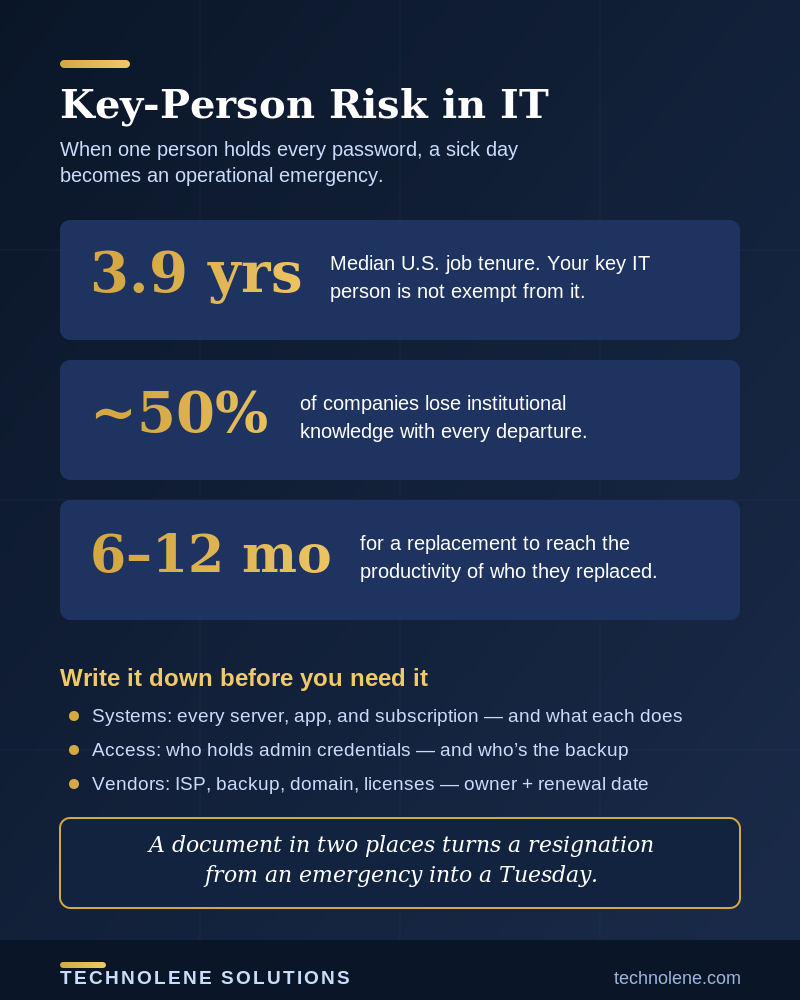
Here’s the part worth sitting with. The median American worker stays in a job about 3.9 years. [1] Your key IT person is not exempt from that. Sooner or later — by choice, by illness, by a better offer — they move on. When they do, research finds that roughly half of companies lose institutional knowledge with every departure, and it takes a new person six to twelve months to reach the productivity of the one they replaced. [2]
Now attach a number. Replacing an employee typically costs somewhere between one and a half and two times their annual salary once you count recruiting, ramp-up, and lost momentum. [3] For a role that also happens to hold every password in the building, the real cost isn’t the salary — it’s the weeks your firm operates half-blind while someone reverse-engineers what the last person knew. On a live project with deadlines, that’s not an inconvenience. That’s exposure.
You’re not insuring against a person leaving. You’re insuring against the map leaving with them.
What to write down before you need it
The fix starts with an afternoon, not a budget. You want a plain inventory of two things: your systems and your access. Systems: every server, every critical application, every subscription, and what each one does. Access: who holds the administrator credentials, where they’re stored, and who the backup is if that person is unreachable. Add the vendor list — internet provider, backup service, domain registrar, key software — with the account owner and renewal date for each.
That single document turns a resignation from an emergency into a Tuesday.
Continuity without hiring a department
Most 20-to-50-person firms can’t justify a full IT staff, and they shouldn’t have to. This is exactly why co-managed IT has become the common path for firms this size — a growing share of small businesses now lean on an outside partner precisely to get access to skills and coverage they can’t hire for on their own. [4] The arrangement keeps your internal person, if you have one, but makes sure they’re not the only one who holds the map. The documentation lives in more than one place. The backup gets tested by someone whose job is to test it. And a sick day stops being a company-wide event.
Where to start
You don’t need to overhaul anything this week. You need to answer one question honestly: if your key IT person didn’t show up tomorrow, how long would it take to keep the firm running? If you’re not sure, that’s the finding.
Technolene helps AEC and manufacturing firms document what lives in one person’s head — systems, access, and vendors — and provides the co-managed coverage that keeps a resignation from becoming an outage. No pressure, no jargon. Just a clear picture of what only one person currently knows.
→ Reach out at technolene.com/contact-us to schedule a conversation.
Sources
- https://www.bls.gov/news.release/tenure.nr0.htm
- https://atlan.com/know/data-for-ai/institutional-knowledge-loss/
- https://www.gallup.com/workplace/247391/fixable-problem-costs-businesses-trillion.aspx
- https://gtia.org/hubfs/GTIA%202025%20SMB%20Technology%20and%20Buying%20Trends%20Research.pdf
- https://technolene.com/contact-us