

Somewhere in your firm this week, someone opened an AI chatbot, could be CoPilot, Gemini, ChatGPT or a myriad of others to get through a deadline. Maybe a project engineer pasted in a section of a spec and asked it to tighten the language. Maybe an estimator dropped in a set of bid numbers and asked for a clean summary. Maybe someone uploaded a client drawing and asked what they might have missed. Each one saved an hour. None of them thought twice about it. And none of it left a trace anyone in your office can see.
This is the thing about AI at work: it doesn’t announce its self, staff rarely shout out how much time they saved by using AI. It simply looks exactly like getting the job done ontime.
What “shadow AI” actually is
The term for this is shadow AI — employees using AI tools nobody approved, on accounts nobody set up, for work nobody is tracking. It isn’t a rebellion, it is creativity, ingenuity, innovation. It’s the same instinct that leads a crew member to bring a better tool from home because it makes getting the job done easier. The trouble is that a personal AI account isn’t a cordless drill. When someone pastes company information in AI, that information leaves your firm through a door, a door you didn’t know was there much less open.
The quiet data-leak channel
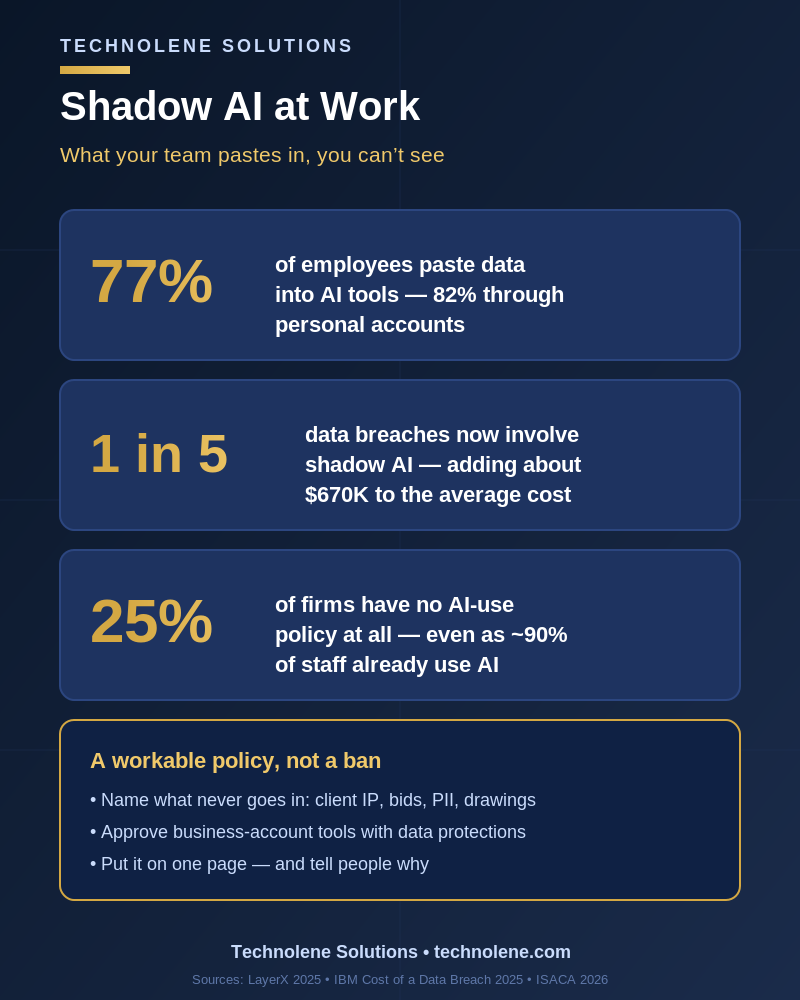
Here’s how common this already is. In a 2025 study of enterprise AI use, roughly 77% of employees were found to paste data into AI tools — and 82% of that activity happened through personal accounts, outside any company control. [1] Read that again: most of the AI use inside a typical organization is happening on logins the business can’t see, secure, or switch off.
For a general office, that’s a concern. For a firm that holds client blueprints, sealed drawings, bid numbers, and regulated project data, it’s something sharper. Every one of those items is exactly the kind of thing that gets pasted into a chatbot to “just check something” — and exactly the kind of thing a client assumed you’d keep locked down.
An unguarded prompt looks exactly like productivity. That’s what makes it easy to miss.
The math of one careless prompt
It’s tempting to file this under theoretical risk. The numbers say otherwise. IBM’s 2025 breach research found that one in five breached organizations was compromised through shadow AI, and that those incidents cost roughly $670,000 more than the average breach. [2] Shadow-AI breaches were also more likely than the typical incident to expose customer personal data.
Put that on a small firm’s scale. You don’t need a multi-million-dollar breach to feel it. A single leaked bid, a set of client drawings in the wrong hands, or a regulated data spill that triggers a notification obligation — any one of those can cost a 30-person firm weeks of billable time, a client relationship, and a reputation that took a decade to build. The exposure isn’t proportional to your headcount. A leaked blueprint is worth the same whether you have 30 employees or 3,000.
Why banning it backfires
The reflex is to shut it down — block the sites, send the email, call it handled. It rarely works. The tools are too useful and too easy to reach on a phone, and a ban just pushes the behavior further out of sight. The real gap isn’t that people use AI. It’s that almost nobody is guiding how. Surveys of organizations find that close to 90% already have employees using AI, while about a quarter have no AI-use policy at all. [3] Everyone’s using it; almost no one has said what’s allowed.
What a workable policy looks like
You don’t need a legal document or a new platform. You need one page that answers three questions your team is currently guessing at.
First, what never goes in. Name it plainly: client drawings and IP, bid and pricing data, anything with personal information, anything covered by a contract or regulation. If it would matter in the wrong hands, it doesn’t belong in a public prompt.
Second, which tools are approved. Pick one or two business-tier tools that keep your data out of training and sit under a company account — so people have a good option and don’t fall back on personal logins.
Third, why it matters. A rule people understand is a rule people follow. Explain that the goal isn’t to slow anyone down; it’s to keep the firm’s — and the client’s — information from walking out an invisible door.
The firms handling this well didn’t ban AI. They spent an afternoon deciding what belongs in it.
Where to start
Start by finding out what’s already happening. Ask your team, without blame, which AI tools they use and what they use them for. You’ll almost certainly learn it’s more than you thought — and that’s the finding. From there, a one-page policy and a short conversation about approved tools does most of the work.
Technolene helps AEC and manufacturing firms put simple, workable AI guardrails in place — a clear policy, approved tools that protect client data, and the visibility to know what’s actually being used. No bans, no jargon. Just a straight answer to a question worth asking: what is your team pasting in?
→ Reach out at technolene.com/contact-us to schedule a conversation.
References
[1] 77% of employees paste data into AI tools; 82% of that activity occurs through personal accounts outside company control (~35% of pasted corporate data is sensitive).
Source: LayerX — Enterprise AI and SaaS Data Security Report 2025
URL: https://go.layerxsecurity.com/hubfs/LayerX_Enterprise_AI_and_SaaS_Data_Security_Report.pdf
[2] One in five (20%) breached organizations was compromised through shadow AI; such incidents cost roughly $670,000 more than the average breach and were more likely to expose customer personal data.
Source: IBM — Cost of a Data Breach Report 2025
URL: https://www.ibm.com/think/x-force/2025-cost-of-a-data-breach-navigating-ai
[3] Close to 90% of organizations report employees using AI, while about 25% have no AI-use policy at all (only ~38% have a comprehensive policy).
Source: ISACA — 2026 AI Pulse Poll
URL: https://www.isaca.org/about-us/newsroom/press-releases