

Most IT budgets aren’t decided. They’re inherited. You take last year’s number, add whatever broke — the server that finally quit, the laptops you had to replace mid-project, the software renewal that jumped — and that becomes this year’s plan. It’s how companies your size come up with that number, and it works well enough that nobody questions it. Right up until someone asks a simple question you can’t answer: is that the right amount?
Nobody built the budget wrong. It just grew the way a garage fills up — one reasonable decision at a time, until you can’t quite say how it got that full.
The number you’re probably starting from
One problem with budgeting by addition is that it doesn’t account for what you competition is doing, no point of reference to the industry. You know what you spent, but not whether it was too much, too little, or exactly right, and on the right things. A firm can carry the same IT budget for three years running and feel disciplined about it, while the ground underneath — the threats, the tools, the licensing — moves every quarter. Steady or flat isn’t the same as right.
What you’re missing is a benchmark, something that gives you an idea of what’s appropriate, a right size. A number you can hold your own spending up against and ask: are we in the range or not, and did we mean to be?
What the benchmark actually says
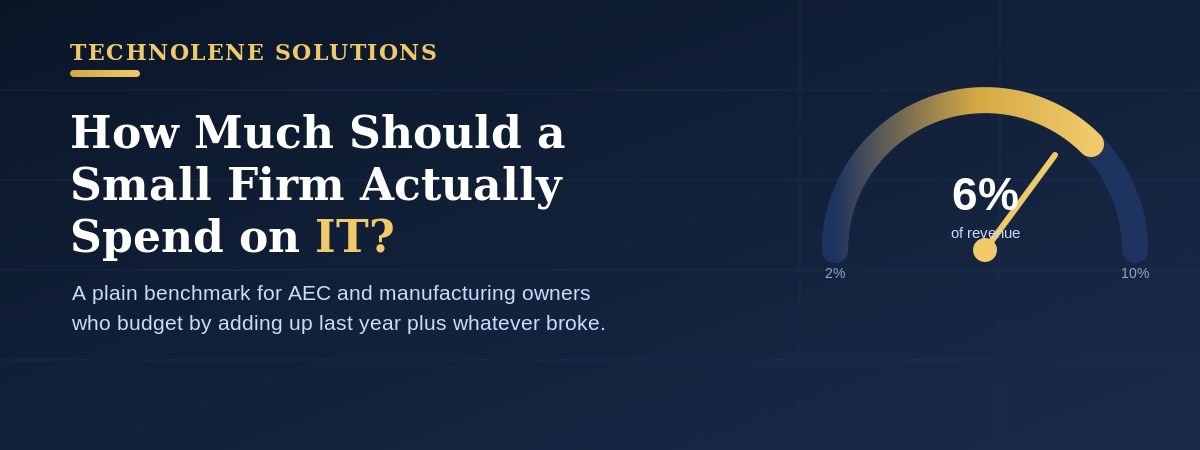
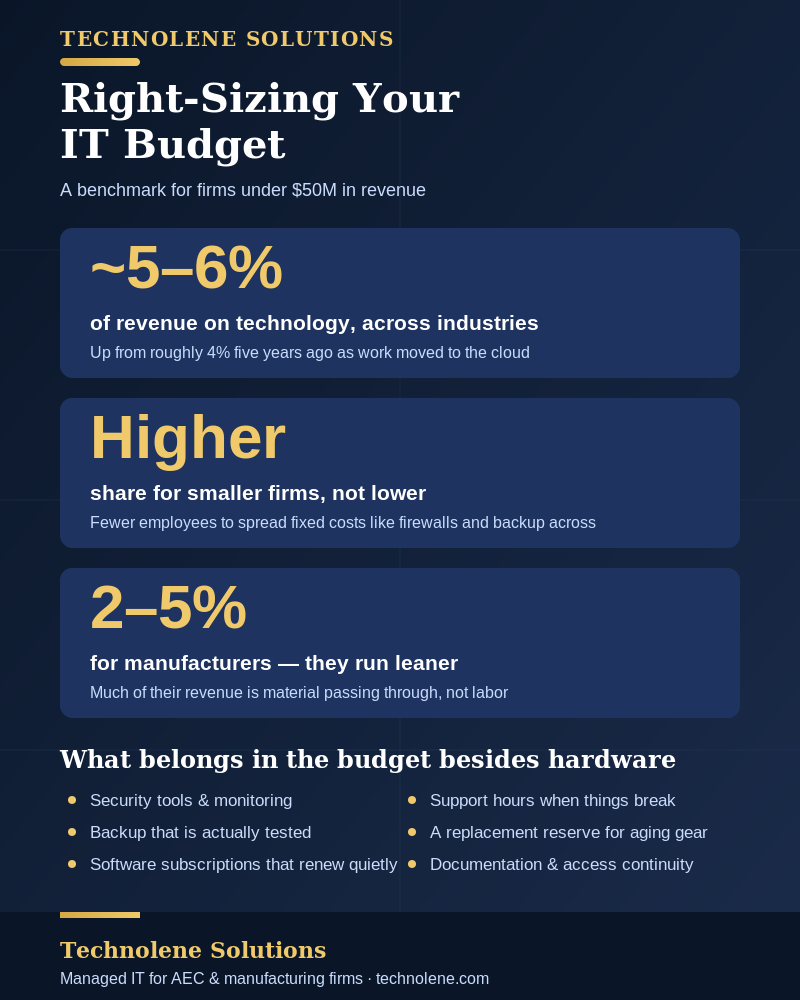
How does a benchmark really help. Looking across industries, we see that businesses spend somewhere in the range of 5 to 6 percent of revenue on technology — a figure that’s climbed from roughly 4 percent five years ago as more of the work moved onto software subscription and cloud.[1] For smaller firms, the share tends to run higher, not lower, that 3 user Quickbooks Online subscription is the same whether you are $1 milllion or $10, in fact companies under $50 million in revenue generally allocate a larger percentage than big enterprises, simple because there are fewer employees to spread the fixed costs across.[2] The office of 30 pays for a firewall and a backup service too — it just has fewer people to divide the bill among.
Put your own numbers in. Say a 30-person engineering practice bills $6 million a year and, when you actually add it up — the Microsoft licenses, the two servers, the backup service, the person who comes when something breaks — spends about $180,000 on IT. That’s 3 percent of revenue. The benchmark for a firm that size sits closer to 6. The $180,000 gap between where you are and where the benchmark points isn’t a bill you suddenly owe. It’s a question worth asking out loud: is that difference a deliberate choice, or just the sum of everything nobody re-examined?
A benchmark isn’t a bill. It’s a mirror.
Why the shop floor runs leaner
If you’re on the manufacturing side, the percentage looks different, and for a good reason. Manufacturers historically run in the 2 to 5 percent range.[3] The reason isn’t that they care less — it’s that a big share of a manufacturer’s revenue is steel, resin, or lumber passing through. Half the “revenue” is material you never touched with a keyboard. Holding a fabricator to the same 6 percent as say an engineering office, would be telling them to spend as if all its revenue were labor, when much of it is raw stock.
That’s why, for material-heavy firms, the honest cross-check isn’t revenue alone — it’s per employee. Fifteen people who each need a workstation, a login, a phone, and a slice of the security and backup that protects them all: that’s a number that scales with the work, not with the price of lumber.
What belongs in the budget besides hardware
The most common mistake isn’t the total. It’s what gets left out. When most owners picture the IT budget, they picture equipment — computers, servers, the occasional network switch. But hardware is the part you can see. The parts that actually keep the firm running tend to be the ones you don’t, they don’t sit on a desk: things like the security and monitoring tools, the backup (that’s actually tested), the software subscriptions that renew quietly on a credit card somewhere, the support hours when something breaks, and a replacement reserve so the next dead server is a line item instead of a surprise.
The hardware is the part you can see. The budget lives in the parts you can’t.
Leave those out and the budget looks lean — right up until one of them fails and becomes an emergency purchase at emergency prices. A firm that spends nothing on tested backups isn’t saving money. It’s deferring a much larger bill to the worst possible week.
Where to start
You don’t need a consultant or a spreadsheet overhaul this week. You need one honest number: what did you actually spend on everything IT last year — hardware, software, security, support, all of it — as a percentage of revenue? Compare it to the range for your size and industry. If you’re well under, that’s not automatically good; it often means something important is going unfunded. If you’re well over, it’s worth knowing why. Either way, you’ll be deciding the number instead of inheriting it.
Technolene helps AEC and manufacturing firms right-size IT spending — benchmarking what you spend against firms your size, and making sure the budget covers the things that don’t sit on a desk. No pressure, no jargon. Just a clear answer to a question worth asking: are you spending the right amount, or just last year’s amount?
→ Reach out at technolene.com/contact-us to schedule a conversation.
References
[1] Across industries, technology budgets average roughly 5–6% of revenue in 2025, up from about 4% five years earlier. Source: Deloitte Insights — Global Technology Leadership Study / “From tech investment to impact.” URL: https://www.deloitte.com/us/en/insights/topics/leadership/maximizing-value-of-tech-investments.html
[2] Companies under $50M in revenue typically allocate a higher share of revenue to IT than large enterprises; small/midsize benchmarking guidance. Source: Gartner — IT Key Metrics Data 2025 / Worldwide IT Spending Forecast. URL: https://www.gartner.com/en/newsroom/press-releases/2026-02-03-gartner-forecasts-worldwide-it-spending-to-grow-10-point-8-percent-in-2026-totaling-6-point-15-trillion-dollars
[3] Manufacturers run leaner on IT as a share of revenue — roughly 2–5% (industrial products near 4.1%). Source: Gartner — IT Key Metrics Data 2025: Industry Measures, Industrial Manufacturing. URL: https://www.gartner.com/en/documents/5972771
Sources
- URL:%20https://www.deloitte.com/us/en/insights/topics/leadership/maximizing-value-of-tech-investments.html
- URL:%20https://www.gartner.com/en/newsroom/press-releases/2026-02-03-gartner-forecasts-worldwide-it-spending-to-grow-10-point-8-percent-in-2026-totaling-6-point-15-trillion-dollars
- URL:%20https://www.gartner.com/en/documents/5972771